
Scotland vs England Income Tax Rates 2025/2026: Tax Bands, Take-Home Pay & Regional Differences
Under the Scotland Acts of 2012 and 2016, the Scottish Parliament holds devolved powers to set Income Tax rates and band thresholds on non-savings and non-dividend income for individuals living in Scotland. As a result, taxpayers in Scotland experience a distinctly different tax structure compared to taxpayers in England, Wales, and Northern Ireland (rUK). If you live, work, or run a business that crosses the Anglo-Scottish border, understanding these nuances is critical for effective financial planning and peace of mind.
Let's be completely transparent: navigating the UK tax system is challenging enough without the added complexity of devolved national rates. Whether you are a long-term resident of Edinburgh, a professional relocating to Glasgow for an exciting new role, or an HR manager handling payroll for a UK-wide workforce, the differing thresholds and marginal rates can induce significant "compliance fatigue." The psychological burden of miscalculating your take-home pay, or worse, making an error on a Self Assessment tax return, is a valid concern shared by thousands of taxpayers every year. This comprehensive guide is designed to alleviate that anxiety. We will break down the 2025/2026 Scottish Income Tax bands, compare them meticulously against the rest of the UK, and provide actionable strategies to manage your wealth proactively.
1. Scottish 6-Band System vs Rest of UK 3-Band System
The foundational difference between Scotland and the rest of the UK (rUK) lies in the structure of the tax brackets. While England, Wales, and Northern Ireland utilize a relatively streamlined 3-band structure (Basic 20%, Higher 40%, and Additional 45%), the Scottish Government has opted for a highly progressive 6-band system. This model was introduced with the stated intention of making the tax system fairer, ensuring that the lowest earners pay slightly less tax while those with higher incomes contribute significantly more to fund public services in Scotland.
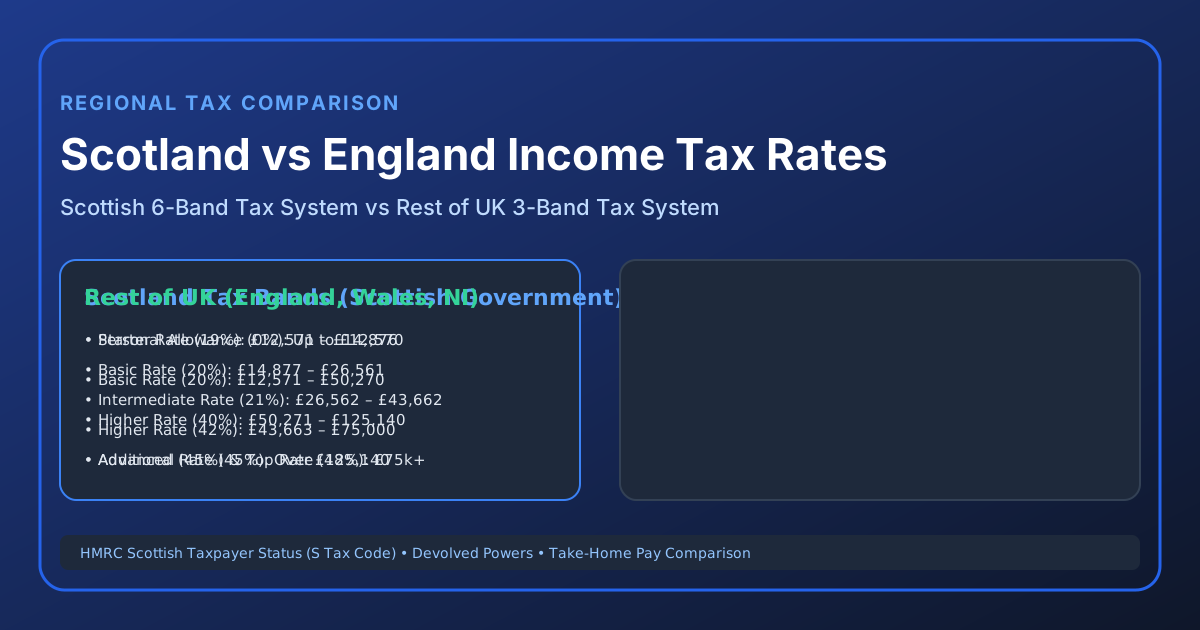
Scottish Income Tax Bands (2025/26)
- Personal Allowance (0%): Up to £12,570. This UK-wide allowance remains unchanged and provides a tax-free foundation for all residents.
- Starter Rate (19%): £12,571 to £14,876. A specialized lower rate designed to reduce the tax burden on part-time workers and entry-level roles.
- Basic Rate (20%): £14,877 to £26,561. Aligned with the rUK Basic Rate, but spanning a much narrower income band.
- Intermediate Rate (21%): £26,562 to £43,662. The point at which middle-income Scottish taxpayers begin paying more than their English counterparts.
- Higher Rate (42%): £43,663 to £75,000. Noticeably higher than the 40% rate in rUK, and kicking in over £6,000 earlier.
- Advanced Rate (45%): £75,001 to £125,140. Introduced as a new band in recent budgets to target upper-middle earners.
- Top Rate (48%): Above £125,140. The highest income tax bracket in the UK, applying a 48% marginal rate to top earners.
Rest of UK Tax Bands (England, Wales, NI)
- Personal Allowance (0%): Up to £12,570. Exactly the same as in Scotland.
- Basic Rate (20%): £12,571 to £50,270. A vast band that covers the majority of the working population, keeping their marginal rate steady at 20%.
- Higher Rate (40%): £50,271 to £125,140. The rate applied to higher earners, starting at a much higher threshold than Scotland's 42% rate.
- Additional Rate (45%): Above £125,140. The top rate for individuals earning substantial incomes, effectively 3% lower than the Scottish Top Rate.
The psychological impact of these differing bands cannot be overstated. For an employee in England, receiving a pay rise from £40,000 to £45,000 means staying entirely within the 20% bracket. For a Scottish taxpayer, that same pay rise pushes a portion of their income into the 42% Higher Rate bracket, creating a feeling of diminishing returns on career progression.
2. Salary Comparison Table: Take-Home Pay Differences
To truly understand the impact of the devolved tax system, we must look at concrete numbers. The Scottish system is designed so that lower earners actually pay slightly less tax than they would in England, thanks to the 19% Starter Rate. However, the "crossover point" occurs at approximately £28,850. Anyone earning above this threshold in Scotland will pay more Income Tax than someone earning the exact same salary in England, Wales, or Northern Ireland. For high earners, this divergence becomes a chasm.
| Gross Salary | England Net Salary | Scotland Net Salary | Annual Difference |
|---|---|---|---|
| £20,000 | £17,120 | £17,143 | +£23 (Scot pays less) |
| £25,000 | £21,120 | £21,143 | +£23 (Scot pays less) |
| £35,000 | £28,320 | £28,256 | -£64 (Scot pays more) |
| £50,000 | £39,520 | £37,978 | -£1,542 (Scot pays more) |
| £75,000 | £54,057 | £51,478 | -£2,579 (Scot pays more) |
| £100,000 | £68,557 | £63,978 | -£4,579 (Scot pays more) |
| £150,000 | £93,124 | £86,220 | -£6,904 (Scot pays more) |
As the table illustrates, an individual earning £50,000 will find themselves over £1,500 worse off annually in Scotland. For senior executives and highly qualified professionals earning £100,000, the gap widens to nearly £4,600. This disparity has sparked intense debate among businesses operating cross-border, with many citing difficulties in recruiting talent to Scottish offices without offering "equalization" bonuses to offset the higher tax burden.
Calculate your exact Scottish vs Rest of UK take-home salary using our UK Income Tax Calculator.
3. The Interaction with National Insurance & Marginal Tax Traps
A crucial element of understanding Scottish tax is recognizing what is not devolved. National Insurance Contributions (NICs) remain a reserved power, set by the UK Government in Westminster. This creates a deeply frustrating anomaly for Scottish taxpayers, resulting in punitive marginal tax rates at specific income levels.
In the UK, the main rate of employee NICs drops from the standard rate (e.g., 8%) to a much lower rate (2%) at the Upper Earnings Limit. In England, this threshold is perfectly aligned with the start of the 40% Higher Rate of Income Tax at £50,270. Therefore, an English taxpayer's marginal rate (Income Tax + NICs) goes from 28% (20% + 8%) to 42% (40% + 2%).
In Scotland, however, the 42% Higher Rate of Income Tax begins much earlier, at £43,663. But the NIC threshold does not drop to 2% until £50,270. This misalignment creates a "marginal tax trap" for Scottish residents earning between £43,663 and £50,270. Within this narrow window, they must pay both the Scottish Higher Rate of Income Tax (42%) and the main rate of National Insurance (8%), resulting in a staggering effective marginal deduction of 50% on every extra pound earned.
4. How HMRC Determines Scottish Taxpayer Status (S Tax Codes)
With such significant financial implications, establishing your correct taxpayer status is paramount. HMRC determines whether you are a Scottish taxpayer based on where you live, not where you work, nor where your employer is headquartered.
If your main place of residence for the majority of the tax year is in Scotland, you are a Scottish taxpayer. When HMRC identifies you as such, they will issue a new tax code to your employer prefixed with the letter S (for example, S1257L instead of the standard 1257L).
- The Main Home Rule: If you have one home and it is in Scotland, the decision is simple. You are a Scottish taxpayer.
- Multiple Homes: If you split your time between a property in Scotland and a property in England, HMRC applies a "day count" test. Whichever country you spend the most days in during the tax year dictates your status.
- Moving Mid-Year: If you relocate from London to Edinburgh halfway through the tax year, you must inform HMRC immediately. Your status for the entire year will be determined by where you spent the majority of your time. This can result in a retroactive tax recalculation.
5. Reserved UK Taxes: NI, CGT & Dividends
While the Scottish Parliament exerts considerable control over your paycheck, a massive portion of the tax system remains under the purview of Westminster. It is vital to remember that the Scottish rates apply exclusively to non-savings employment income, self-employment profits, and pension income.
The following taxes remain completely uniform across the entire United Kingdom, regardless of whether you live in Inverness or Islington:
- National Insurance Contributions: Class 1 (employees), Class 2, and Class 4 (self-employed) rates and thresholds are UK-wide.
- Capital Gains Tax (CGT): The rates (currently 10%, 18%, 20%, 24% depending on asset type and income) and the annual exempt amount apply uniformly.
- Dividend Tax: If you are a Scottish company director paying yourself via dividends, your dividend income is taxed at the UK rates (8.75% Basic, 33.75% Higher, 39.35% Additional), not the Scottish rates. This creates unique tax planning opportunities for Scottish business owners.
- Savings Interest: The Personal Savings Allowance and the tax rates applied to interest generated by savings accounts remain set by Westminster.
- Inheritance Tax (IHT) and Corporation Tax: Both are entirely reserved UK taxes.
6. Proactive Strategies for Scottish Taxpayers
Moving beyond basic compliance, the smartest taxpayers in Scotland utilize legal, structured strategies to mitigate the impact of the higher rates. This is where you transition from passive acceptance to proactive wealth management.
- Salary Sacrifice for Pensions: Because Scottish marginal tax rates are higher, the tax relief on pension contributions is correspondingly more generous. A Scottish taxpayer earning £60,000 who makes a pension contribution receives 42% tax relief, compared to 40% in England. Utilizing salary sacrifice can rapidly pull your taxable income below the punitive £43,663 threshold, avoiding the 50% marginal trap entirely.
- Maximizing ISAs and Tax-Free Wrappers: Shielding your investments inside an Individual Savings Account (ISA) is even more critical in Scotland. Any income or capital gains generated within an ISA are protected from HMRC, ensuring that your wealth compounds efficiently without being eroded by the 42%, 45%, or 48% bands.
- Corporate Structuring: For entrepreneurs and contractors, operating through a Limited Company and remunerating yourself via dividends rather than a straight salary can bypass the Scottish Income Tax bands altogether. Since dividend tax is a reserved UK power, Scottish directors pay the exact same dividend tax rates as English directors, often resulting in a far more favorable net outcome.
Ultimately, navigating the divergence between Scotland and England requires a tailored approach. By prioritizing structured planning, meticulous documentation, and professional advice, you can turn a heavy compliance burden into a strategic financial advantage.