
UK Income Tax Rates 2025/2026 & 2026/2027: Brackets, Personal Allowance & Take-Home Salary Guide
Understanding how your hard-earned salary is taxed in the United Kingdom is fundamental to holistic financial planning. Whether you are actively negotiating a new salary, calculating monthly household budgeting, optimizing workplace pension contributions, or just attempting to decode the sometimes bewildering contents of your monthly payslip, grasping the nuances of HMRC Income Tax bands, National Insurance thresholds, and the dreaded Personal Allowance taper helps you confidently maximize your net take-home pay and secure your financial future.
In this comprehensive, E-E-A-T-aligned guide, we will break down the complexities of the UK tax system for the 2025/2026 and 2026/2027 tax years. With living costs and inflation consistently at the top of mind for many, optimizing your tax exposure is more critical than ever before. Navigating the tax landscape shouldn't feel like deciphering ancient runes. With a touch of empathy for the genuine headaches that HMRC forms can cause, and a heavy dose of expert guidance, we aim to transform you from a passive taxpayer into a proactive tax strategist.
1. UK Income Tax Rates & Bands 2025/2026
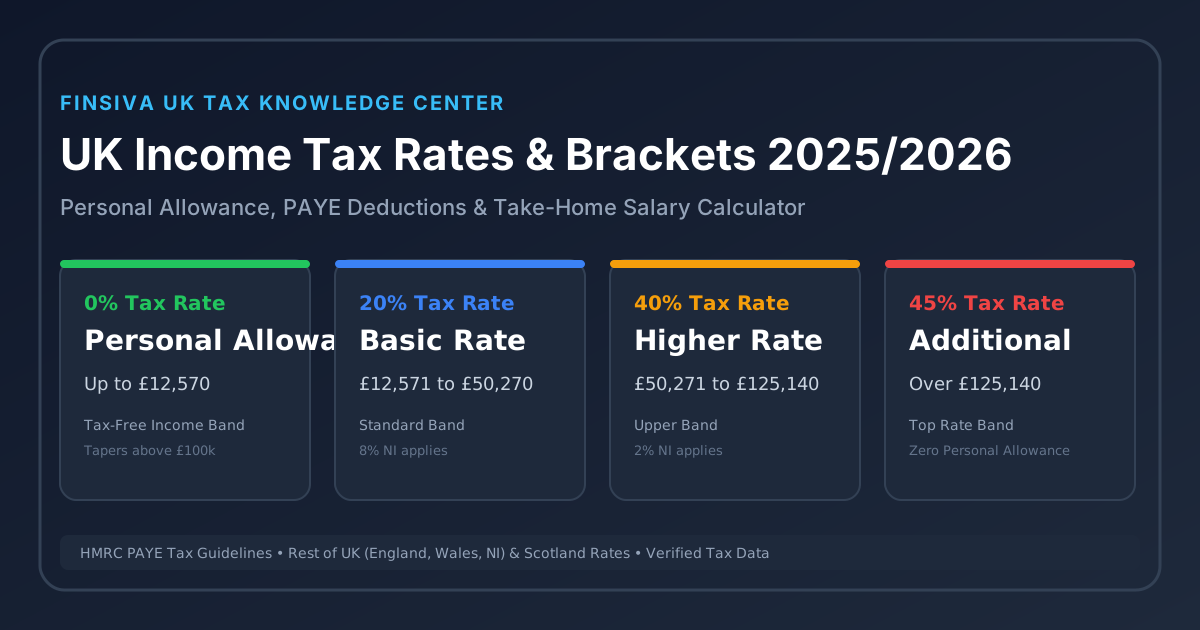
The UK tax system is fundamentally progressive, which means that higher portions of your income are taxed at higher marginal rates. This is designed to ensure that those who earn more contribute a larger percentage of their income to public services, maintaining societal balance. For taxpayers residing in England, Wales, and Northern Ireland, HM Revenue & Customs (HMRC) applies the following Income Tax bands for the 2025/2026 tax year (which largely remain frozen through to 2028 due to fiscal drag policies):
| Tax Band | Taxable Income Threshold | Tax Rate |
|---|---|---|
| Personal Allowance | Up to £12,570 | 0% |
| Basic Rate | £12,571 to £50,270 | 20% |
| Higher Rate | £50,271 to £125,140 | 40% |
| Additional Rate | Above £125,140 | 45% |
Let's look at a concrete example to demystify this. If you earn £60,000 a year, you do not pay 40% on the entire £60,000. Instead, you pay 0% on the first £12,570, 20% on the amount between £12,571 and £50,270 (£37,700 taxed at 20% = £7,540), and 40% only on the remaining £9,730 that falls into the Higher Rate band (£9,730 taxed at 40% = £3,892). This marginal structure is very often misunderstood, causing unnecessary panic when an employee receives a pay rise that ostensibly "pushes them into the next tax bracket." Your overall effective tax rate is always lower than your highest marginal tax rate.
You can effortlessly test different salary figures, bonus payouts, and scenarios using our free UK Income Tax Calculator.
2. Personal Allowance & The £100,000 Tax Trap (60% Marginal Rate)
Standard UK taxpayers receive an annual tax-free Personal Allowance of £12,570. This acts as a foundation of tax-free earning to support basic living costs before HMRC takes a cut. However, high earners face a significant cliff edge known notoriously as the £100,000 Personal Allowance Taper.
As your 'adjusted net income' exceeds £100,000, HMRC begins to aggressively claw back this allowance. It does so at a strict rate of £1 for every £2 earned above the £100k threshold. This means that by the time your income reaches exactly £125,140, your entire £12,570 Personal Allowance has been wiped out completely.
Warning: The 60% Marginal Tax Rate
Between £100,000 and £125,140, this loss of tax-free allowance coupled with the standard 40% Higher Rate tax results in an effective 60% marginal tax rate. If we factor in the additional 2% National Insurance (which continues to apply at this level), you are effectively keeping only 38 pence of every £1 you earn in this income window! This is widely considered one of the harshest quirks of the UK tax system, serving as a severe disincentive for earning between these amounts. Fortunately, it can be mitigated with clever pension planning, which we cover below.
3. Class 1 National Insurance Contributions: The Hidden Tax
Income tax is only one part of the take-home pay equation. Employees also pay Class 1 National Insurance (NI) through the PAYE (Pay As You Earn) system. National Insurance was originally designed to fund state benefits, including the State Pension, statutory sick pay, and maternity leave, though today it essentially acts as a secondary income tax.
The rates for employees have fluctuated notably in recent years due to successive budget policy shifts, but as of the current legislation for 2025/2026, the structure is as follows:
- Main Rate (8%): Deducted on weekly earnings between the Primary Threshold (£242 per week or £12,570 per year) and the Upper Earnings Limit (£967 per week or £50,270 per year).
- Upper Rate (2%): Deducted on all earnings above £50,270 per year.
Crucially, unlike Income Tax, which is calculated on an annual cumulative basis across the whole tax year, National Insurance is calculated purely on a per-pay-period basis (e.g., weekly or monthly). This means that a sudden, large bonus in one specific month could see a spike in your NI contributions for that specific month, which doesn't get balanced out over the rest of the year.
4. Gross to Net Salary Comparison Table (£30k to £120k)
Theoretical percentages are useful, but practical numbers paint the clearest picture of your true financial standing. The detailed table below provides a breakdown of Income Tax, Class 1 National Insurance, and annual net take-home salary for common UK benchmark gross incomes. These figures assume you have a standard 1257L tax code, are not making any pension contributions (which would lower your tax bill), are under State Pension age, and do not have a student loan deduction.
| Gross Salary | Income Tax | Class 1 NI | Annual Take-Home | Monthly Take-Home |
|---|---|---|---|---|
| £30,000 | £3,486 | £1,394 | £25,120 | £2,093 |
| £40,000 | £5,486 | £2,194 | £32,320 | £2,693 |
| £50,000 | £7,486 | £2,994 | £39,520 | £3,293 |
| £60,000 | £11,432 | £3,211 | £45,357 | £3,780 |
| £70,000 | £15,432 | £3,411 | £51,157 | £4,263 |
| £100,000 | £27,432 | £4,011 | £68,557 | £5,713 |
| £120,000 | £44,432 | £4,411 | £71,157 | £5,930 |
5. Decoding Your Payslip, Tax Codes & Adjusted Net Income
Your employer relies on a Tax Code provided by HMRC to calculate exactly how much tax to deduct from your gross pay. For the vast majority of full-time employees holding a single job, the tax code is 1257L. This signifies that you are entitled to the standard £12,570 Personal Allowance.
However, things can get complicated incredibly quickly if you have multiple jobs, taxable company benefits (like a company car, private medical insurance, or gym memberships), or owe tax from a previous year.
- BR (Basic Rate): All income from this job is taxed at a flat 20% with no personal allowance applied. Often used for a second job.
- D0: All income is taxed at a flat 40%. Typical for a second job when the primary job uses the full basic rate band.
- K Codes (e.g., K450): This means you have deductions (like owed tax or large company benefits) that exceed your Personal Allowance. Instead of getting a tax-free allowance, an amount is effectively added to your taxable pay.
- W1/M1 (Emergency Tax): This signifies a non-cumulative tax code. Tax is calculated purely on that specific pay period's earnings, ignoring year-to-date figures. This often results in overpaying tax until HMRC issues a correct cumulative code.
Always meticulously check your payslip. HMRC occasionally makes mistakes, and if you are on an incorrect or 'emergency' tax code, you could be significantly overpaying tax month to month. Overpaid tax can be claimed back, but it's much better to have the cash flowing into your bank account now to invest or spend, rather than waiting for an eventual rebate.
6. Impact of Student Loans and HICBC on Take-Home Pay
Beyond standard Income Tax and National Insurance, two major factors drastically reduce your take-home pay:
- Student Loan Repayments: Depending on when you started university, you may be on Plan 1, Plan 2, Plan 4 (Scotland), Plan 5, or have a Postgraduate loan. For example, Plan 2 loans take 9% of your income above £27,295. If you earn £50,000, you pay 9% on £22,705—which equates to over £2,000 a year leaving your payslip. This functions as an additional 9% marginal tax, pushing the marginal rate for a basic rate taxpayer to 31%, and a higher rate taxpayer to 51%.
- High Income Child Benefit Charge (HICBC): As of the April 2024 changes carrying into 2025/2026, if you or your partner earn over £60,000, you must start repaying Child Benefit. The charge is 1% of the total Child Benefit for every £200 earned over £60,000, meaning the benefit is fully wiped out at £80,000. This charge creates an additional marginal tax rate spike between £60k and £80k.
7. Proven Strategies to Reduce Your Taxable Income
While tax evasion is highly illegal and severely penalized, tax avoidance—the process of structuring your finances efficiently within the boundaries of the law—is a sensible, expected, and encouraged practice. Here are the most effective, HMRC-approved ways to lower your taxable income in the UK:
- Salary Sacrifice Pension Contributions: This is arguably the most powerful tool available to employees. By agreeing to give up a portion of your gross salary in exchange for an equivalent employer contribution to your pension, you avoid both Income Tax and National Insurance on that amount. For those facing the punitive 60% tax trap between £100k and £125k, contributing the excess into a pension effectively reclaims your Personal Allowance, offering enormous tax efficiency (a 60% immediate uplift on the money saved).
- Marriage Allowance: If you are married or in a civil partnership, and one partner earns less than the £12,570 Personal Allowance while the other is a Basic Rate taxpayer, the lower earner can transfer 10% (£1,260) of their allowance to their partner. This reduces the household tax bill by up to £252 per year. It's shockingly under-utilized, with HMRC estimating over a million eligible couples miss out annually.
- Cycle to Work and EV Schemes: Many employers offer salary sacrifice schemes for bicycles or Ultra-Low Emission Vehicles (EVs). Like pensions, these deductions come directly out of your gross pay before tax, saving you Income Tax and NI while providing you with transportation.
- Work-Related Expenses: If you incur costs directly related to your employment that your employer doesn't reimburse, you can claim tax relief. This includes professional subscriptions (e.g., ACA, ACCA, BMA, union fees), uniform washing allowances, working from home allowances (if mandated), and sometimes essential tools or equipment.
- Charitable Donations (Gift Aid): If you are a Higher (40%) or Additional (45%) rate taxpayer, donating to a registered charity via Gift Aid allows you to claim back the difference between the basic rate and your highest tax rate on the donation through your Self Assessment tax return.
8. Scottish Income Tax: How it Differs
It is absolutely vital to note that if your main home is in Scotland, different Income Tax rates and bands apply to your non-savings and non-dividend income. The Scottish Government has devolved powers over income tax and has chosen to introduce a much more granular banding system to raise additional revenue.
For the 2024/2025 tax year and moving into 2025/2026, Scottish taxpayers face six distinct bands (Starter, Basic, Intermediate, Higher, Advanced, and Top), with rates ranging from 19% up to 48%. Crucially, the Higher Rate (42%) in Scotland kicks in at a much lower threshold (£43,663) compared to the rest of the UK (£50,270). If you are moving to or from Scotland, your tax code will prefix with an 'S' (e.g., S1257L), and you must notify HMRC promptly of your change of address to avoid underpaying or overpaying.